Thank you New Bee, Barbara Dillard, J.J. Loughran, John R Brakey, Bud Jones, and many others for tuning into Suri Crowe’s live video!
Lulu Friesdat joins the interview at 2 minutes in, due to some technical difficulties. We suggest you start watching there.
Join Suri for her next live video in the app!
Links & Background Info on Topics Discussed
Suri & Lulu discussed the SMART Legislation lawsuit challenging the results of the 2024 Senate & Presidential election in Rockland County, NY.
Background information is available on the SMART Elections website: SMARTelections.us, click on lawsuits.
The graphs showing the affidavits where more voters voted for Independent Senate candidate Diane Sare than were counted by the Rockland County Board of Elections are here (Ramapo 39) and here (Ramapo 62). The numbers are small, but the percentage of missing Sare votes is close to 50% in both districts. If that is extrapolated across the county, those are huge numbers of missing votes.
Here is the drop-off analysis of New York showing large and surprising disparities between the presidential and Senate races of both Democrats and Republicans. In New York state overall, 9% of Trump’s vote is above the Republican Senate candidate and over 2% of Harris’ results are below the Democratic Senate candidate. SMART Elections looked at the data that way, because they’re trying to estimate what part of Trump’s vote might be a statistical overperformance (votes potentially added); and what part of Harris’ vote might be a statistical underperformance (votes potentially missing).
The Rockland County drop-off numbers are available on the SMART Elections’ New York State data spreadsheet. In Rockland County 23% of Trump’s vote is above the Republican Senate candidate (votes potentially added); 9% of Harris’ vote is below the Democratic Senate candidate (votes potentially missing).
Those same irregularities are repeated in states across the country and are most pronounced in the swing states they examined.
Research done by experts at Harvard, Yale, Columbia and MIT shows that drop-off in 2020 averaged 1-2%. ”Using this data, we show that in battleground states, 1.9 percent of solid Republicans (as defined by their congressional and state legislative voting) in our database split their ticket for Joe Biden, while 1.2 percent of solid Democrats split their ticket for Donald Trump.”
The fact that the drop-off was so different in 2020 (1-2%), makes the 2024 drop-off (-9 to 23% in Rockland County) more unusual.
Experts would like to explain the irregularities in Rockland County, New York as being completely the result of Hasidic voters in the town of Ramapo, (one of the Rockland County towns) who may have voted “en bloc” (in unison) for Trump for president and the Democratic Senate candidate Kirsten Gillibrand in that race.
However, there is a remarkable statistical analysis of the presidential votes in the non-Hasidic districts in Rockland County, New York. It compares 2020 drop-off to 2024 drop-off, and finds that on the Democratic side the p-value (probability-value) is zero. Meaning the 2024 Democratic results are highly unlikely when compared to the 2020 Democratic results. (Yes, you can have a p-value of zero, SMART Elections will do a separate Substack on it).
The Nuances of Bloc Voting in Rockland County

In the latest SMART Elections press release, they explain that the Hasidic vote is one possible explanation for these unusual voting patterns, but it is not the only explanation. Here is the excerpt from the SMART Elections press release in regard to the predominantly Hasidic votes in Rockland County New York.
“Another oddity in the county's election results was not cited in the original petition, but was discovered after the lawsuit was filed. In multiple districts hundreds of voters chose the Democratic candidate Kirsten Gillibrand for Senate, but zero votes were recorded for the Democratic Presidential candidate Kamala Harris. Many scholars have pointed to "bloc" voting in Hasidic Communities as the reason for these Harris zero-vote districts. "Bloc" voting is where voters make candidate selections based on the recommendations of a leader. This is one possible explanation for the zero-vote districts, but it does not rule out other explanations.”
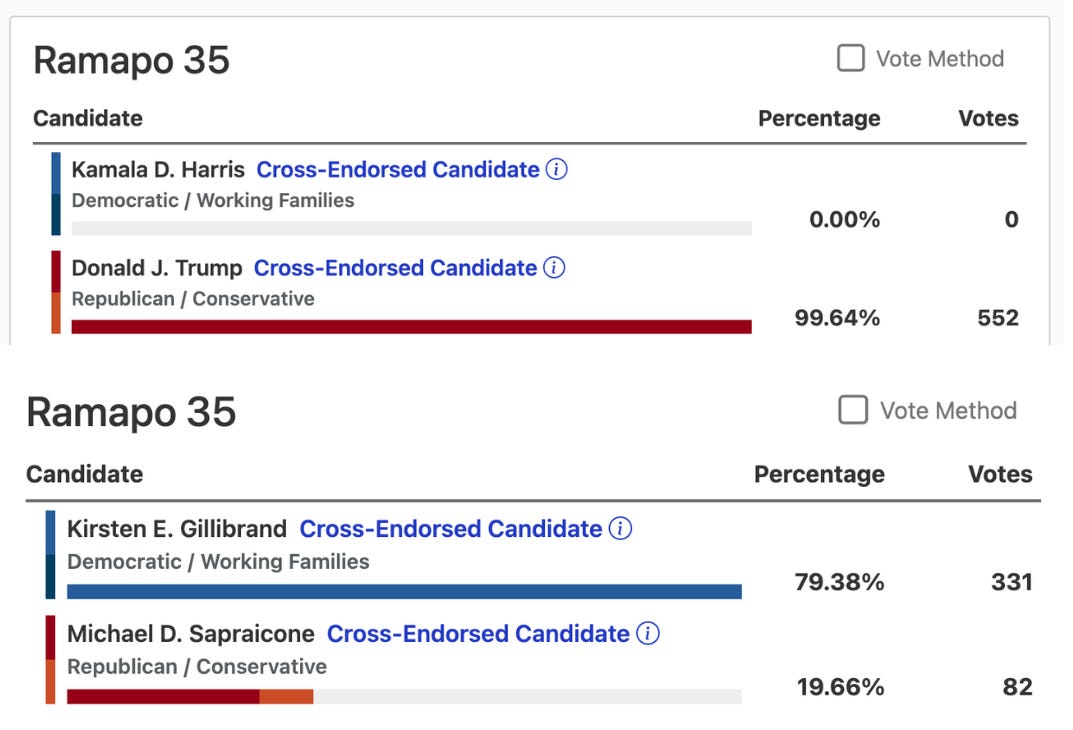
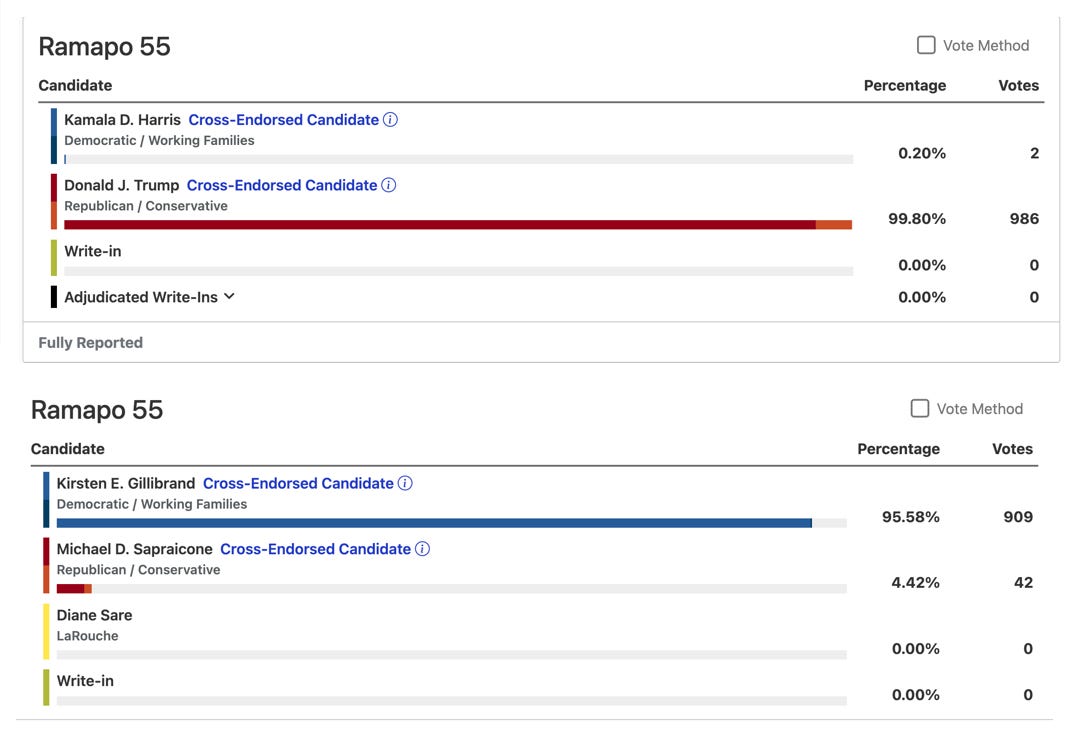
“Local Rockland County reporting indicates that there are many times when Hasidic communities do not vote as one monolithic block, ‘How those votes could go … is unpredictable, complicated by the fragmentation of votes among multiple Hasidic and Orthodox voting groups, particularly in Rockland, in spite of the popular misconception of a single voting bloc.’ Referring to statements from Yossi Gestetner, co-founder of the Orthodox Jewish Public Affairs Council and a Rockland resident, the article says, there are ‘thousands of other Hasidic and Orthodox voters in Rockland with varying degrees of fidelity to the political endorsements of community leaders.’ "
More Background, Discussed in the Suri Crowe - Lulu Friesdat Interview:
The 2016 Election of the Chair of the DNC Was Suspect
In the opening question, Lulu delves into a Congressional race that she investigated in 2016 and 2018.
It was the race between the Congresswoman who at the time was the chair of the DNC, Debbie Wasserman Schultz, and independent challenger Tim Canova. This was in Broward County Florida. The election results looked suspect. Friesdat and Canova requested to view the ballots and the Broward County Supervisor of Elections (after a lengthy lawsuit) illegally destroyed the ballots, rather than let the public view them.
Here is Friesdat’s blog post from the time. The post includes the link to the summary judgment against the Broward County Supervisor of Elections.
Many of the links are offline due to the passage of time, but Friesdat and Canova had a huge legal win in that case. The judge said that Broward County’s defenses were, “without substance in fact or law.”
Here is the analysis that Friesdat and a data scientist she worked with at the time put together of the Broward County 2016 Congressional election results. The analysis shows the discrpenacies in the number of voters who voted and the number of ballots cast in each precinct in this 2016 Broward County Congressional election. In almost every precinct there were either more ballots than voters, or more voters than ballots. Out of 211 precincts, only 19 have the same number of voters and ballots. Notice that in most of the precincts, it is more ballots than voters. You’re never supposed to have more ballots than voters. In total, it’s over a 1000-vote discrepancy in the race.
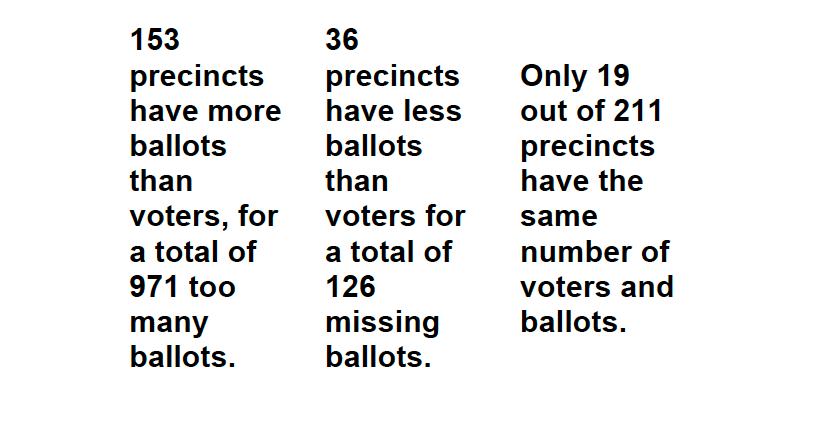
You might say this is water under the bridge, but at the time, this was the hugely consequential race of the chair of the Democratic National Committee to her seat in Congress. The DNC was in the process of admitting that they had rigged the 2016 Democratic primary against Bernie Sanders, by not treating him fairly and not giving him the same support that they gave to Hillary Clinton. The DNC successfully claimed in court that they had a legal right to rig the primary, because it was the Democratic primary, not a state-run election. So they argued they could behave however they wanted.
During the primary, there were massive objections by Sanders’ voters to the entire process. Friesdat was at the DNC in 2016 where crowds of voters pounded on the fence outside the arena shouting in unison, “Election fraud! Election fraud!”
The Wasserman Schultz election was another indication that the elections were not being run accurately or fairly.
However, mainstream media did not cover it in any meaningful way, and eventually most people moved on.
Friesdat brings this up in answer to Crowe’s question about the fact that Democrats, especially mainstream Democrats, don’t want to discuss this issue. They want to claim that the elections are fine and there are no irregularities.
Friesdat’s point is simply that there have been irregularities in election results for decades, really centuries, and we have to stop pretending as a nation that our elections are perfect if we’re going to achieve meaningful reform.
The EVEREST Report: Disastrous Election Security in Ohio
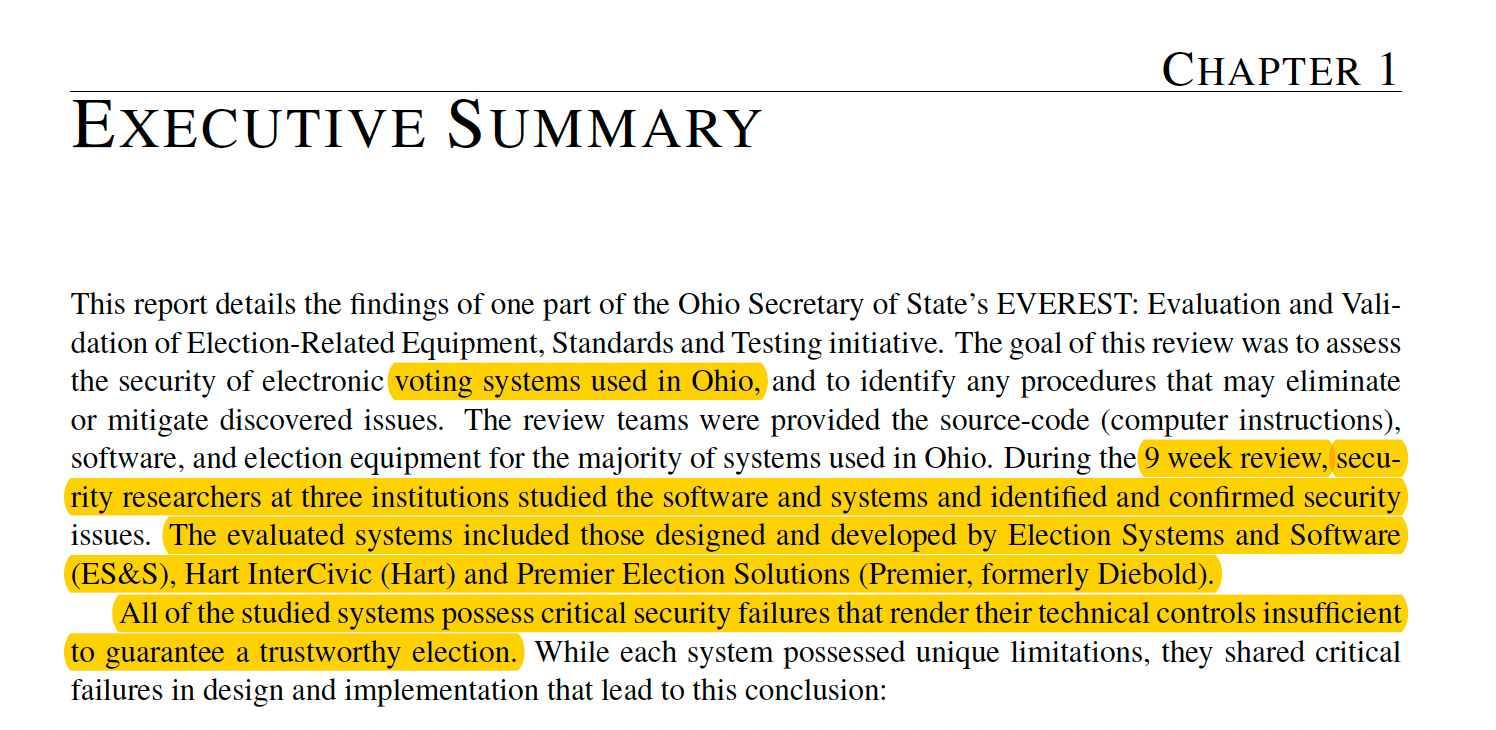
In 2007, a report called the EVEREST Report was released. EVEREST is an acronym standing for: “Evaluation and Validation of Election-Related Equipment, Standards and Testing.” It was commissioned by the then-Secretary of State of Ohio, and it examined all of the voting machines in use in Ohio at the time. The executive summary reads, “During the 9 week review, security researchers at three institutions studied the software and systems … developed by Election Systems and Software (ES&S), Hart InterCivic (Hart) and Premier Election Solutions (Premier, formerly Diebold).”
“All of the studied systems possess critical security failures that render their technical controls insufficient to guarantee a trustworthy election.”
In 2018, Friesdat investigated the voting machines in Ohio and found that in that 11 years they had done basically nothing to improve the security vulnerabilities of the voting systems that were revealed in the EVEREST Report. They were still running the same systems with no meaningful security patches.
Here is Aaron Ockerman, the Executive Director of the Ohio Association of Election Officials admitting that no voting machines were decertified after the EVEREST Report was released. They continued to use the same voting machines, and in 2018 were still using the exact same voting machines in over 70 counties.
The idea that U.S. elections are secure, and have always been secure is not supported by the facts.
Since that time, Ohio has updated it’s voting machines and many counties have switched to hand-marked paper ballots. But for 11 years they used voting systems that they were well-aware were very insecure.
In the full piece, we discuss legislation that was pending in Ohio that would have mandated a hand-marked paper ballot system. Security experts recommend hand-marked voting systems as the most secure. But that legislation did not pass the Ohio legislature. The candidate who supported that position also did not win.
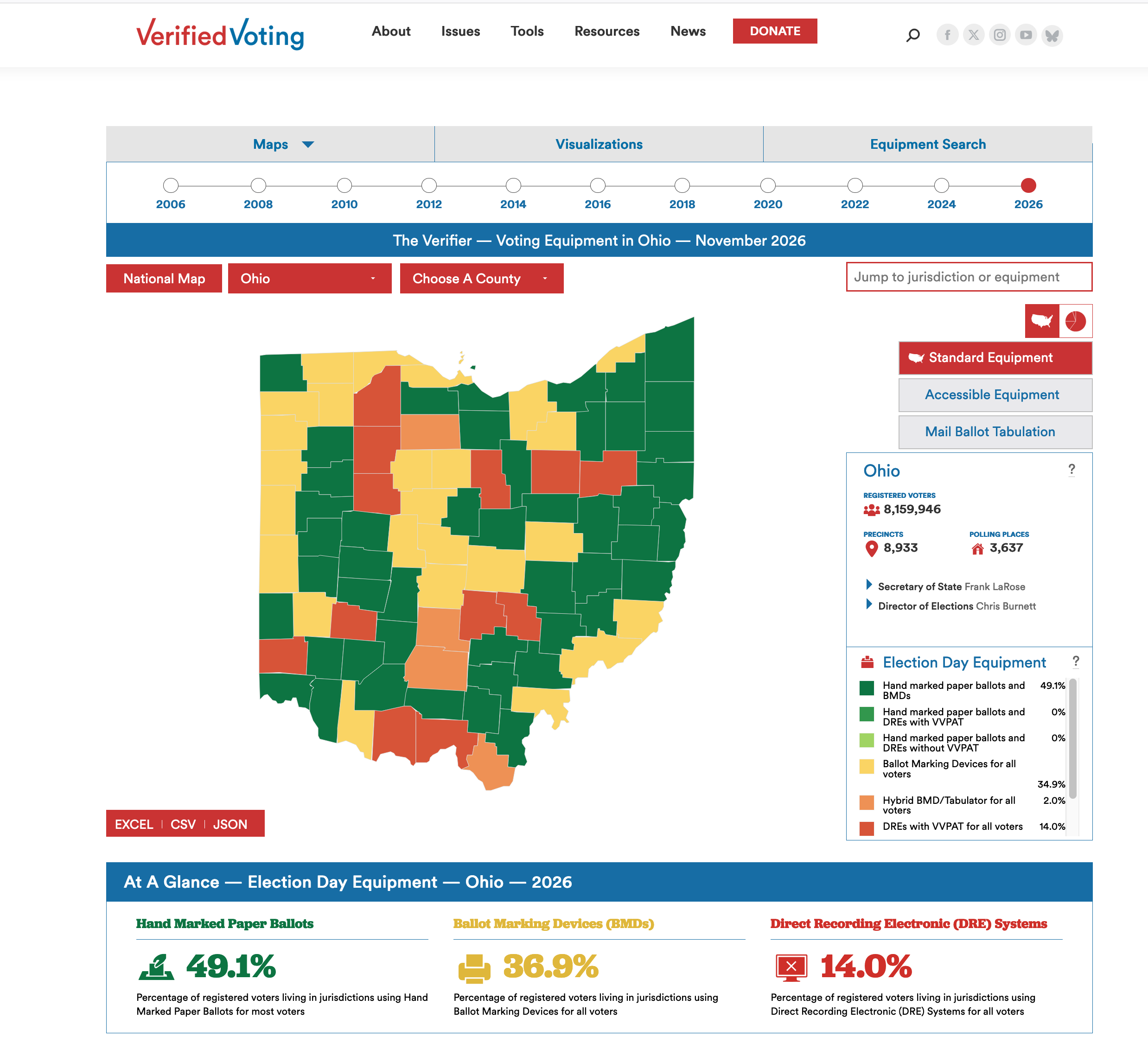
Today there are many counties in Ohio that are using all computerized voting machines that encode the vote in a barcode. Many other counties use a ballot-marking device (computer) to mark their ballot. According to Verified Voting, a nonprofit that tracks voting equipment, less than half the counties in Ohio currently use a hand-marked paper ballot system today (the system that security experts recommend.) The counties in red below have no paper ballots at all.
Below is the full investigation that Friesdat produced and directed for Now This, about the voting machines in Ohio in 2018. Keep in mind that the midterms in the piece being referred to were the 2018 midterms, but the situation was remarkably similar to what is happening now.
We hope you found this Substack Live illuminating and engaging.
Please become a paid subscriber to Suri Crowe’s Substack.
And consider making a tax-deductible donation to SMART Elections.
Thanks for all that you do!